HistoryLondonBridge2


History of the London Bridge


The World Famous London Bridge -- for centuries the sole thread across the Thames, saw both ceremonial entries into the city of London and rebellious challenges.


The southern gatehouse, the Stone Gateway, became the scene of one of London's most notorious sights: a display of the severed heads of traitors, impaled on pikes and dipped in tar to preserve them against the elements. The head of William Wallace was the first to appear on the gate, in 1305, starting a tradition that was to continue for another 355 years. Other famous heads on pikes included those of Jack Cade in 1450, Thomas More in 1535, Bishop John Fisher in the same year, and Thomas Cromwell in 1540. A German visitor to London in 1598 counted over 30 heads on the bridge. The practice was finally stopped in 1660, following the Restoration of King Charles II.


The Old London Bridge of nursery-rhyme fame was built by Peter of Colechurch between 1176 and 1209, replacing an earlier timber bridge. Because of uneven construction the bridge required frequent repair. The bridge survived more than 600 years.


By the end of the 18th century, it was apparent that the old London Bridge needed to be replaced. It was narrow and decrepit, and blocked river traffic. In 1799, a competition for designs to replace the old bridge was held and the bridge was eventually replaced by a structure of five stone arches, designed by engineer John Rennie. Work began in 1824 and the foundation stone was laid, in the southern cofferdam, on June 15, 1825. The old bridge continued in use as the new bridge was being built, and was demolished after the latter opened in 1831. The scheme necessitated the building of major new approach roads, which cost three times that of the bridge itself. The total construction cost of around £2.5 million was met by the Corporation of London and government.


In 1896, it was estimated that the bridge was the busiest point in London, with 8,000 people crossing the bridge by foot and 900 crossing in vehicles every hour. London Bridge was widened in 1902–04 from 52 to 65 feet (16 to 20 m), in an attempt to combat London's chronic traffic congestion. In the end, the widening work proved too much for the bridge's foundations; it was subsequently discovered that the bridge was sinking an inch (3 cm) every eight years. By 1924, the east side of the bridge was some three to four inches (102 mm) lower than the west side; it soon became apparent that this bridge would have to be removed and replaced with a more modern one.


In 1967, the Common Council of the City of London placed the bridge on the market and began to look for potential buyers. On 18 April 1968, Rennie's bridge was sold to the American entrepreneur Robert P. McCulloch of McCulloch Oil for $2,460,000. When casting his bid for the bridge, McCulloch doubled the estimated cost of dismantling the structure, which was $1.2 million, bringing the price to $2.4 million. He then added on $60,000, a thousand dollars for each year of his age at the time he estimated the bridge would be raised in Arizona. His gesture earned him the winning bid.


-------- -------------

-------------London Bridge Under Construction--------------------------------London Bridge today


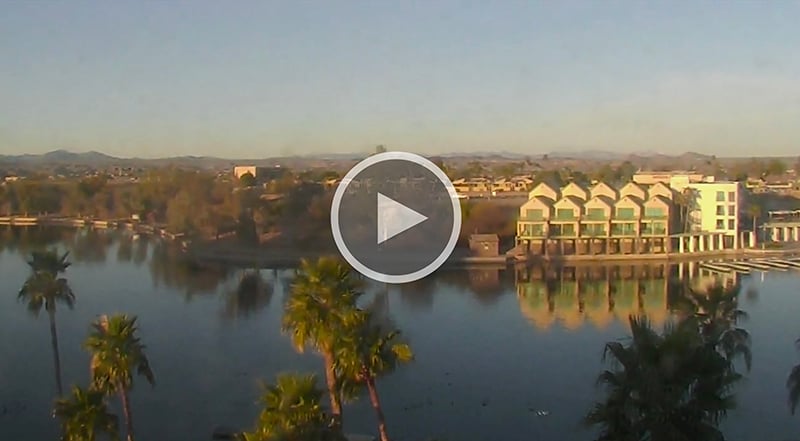
As the bridge was taken apart, each piece was numbered to aid re-assembly. The bridge was reconstructed in Lake Havasu City, and re-dedicated on 10 October 1971. The reconstruction of Rennie's London Bridge spans the Bridgewater Channel canal that leads from Lake Havasu to Thomson Bay. Rennie's London Bridge has become Arizona's second-biggest tourist attraction, after the Grand Canyon.

 
PHOTO GALLERY - HISTORY OF LONDON BRIDGE
 

Local News

Havasu Video News


Click HERE For

Lake Havasu Video News

CVB - Position Opportunities